


 Saeed Ahmadi

Introduction
Motivation and success are among the most widely studied topics in psychology and neuroscience. Understanding how they interact can provide valuable insights into personal growth and long-term achievement.
Why do some individuals achieve remarkable success despite possessing only average levels of talent, while others with significant abilities struggle to reach their goals? Modern psychology and neuroscience suggest that the answer lies not merely in intelligence, willpower, or luck, but in the cognitive and motivational systems that shape human behavior.
Over the past several decades, researchers have identified specific psychological and neurological mechanisms that influence persistence, performance, and long-term achievement. The encouraging finding is that many of these mechanisms can be developed through deliberate practice and self-awareness.
Understanding how motivation works, how the brain responds to goals and rewards, and how mindset influences behavior provides a scientific foundation for personal growth and lasting success.
What Is Motivation and Why Does It Matter?
From a psychological perspective, motivation is defined as the process that initiates, directs, and sustains behavior toward specific goals. Edward Deci and Richard Ryan, in their influential Self-Determination Theory, distinguish between two primary types of motivation:
- Intrinsic Motivation: When a person pursues an activity for the pleasure, curiosity, or inherent value it provides.
- Extrinsic Motivation: When the primary driver is external rewards — money, social approval, or the avoidance of punishment.
Research has consistently shown that individuals with stronger intrinsic motivation perform better over the long term, experience greater satisfaction, and demonstrate higher levels of resilience.
The Brain and Success: The Role of Dopamine
The brain’s reward system — particularly the dopaminergic pathway — plays a central role in shaping motivation. Contrary to popular belief, dopamine is released not only at the moment of receiving a reward, but in anticipation of it. This means our brains are wired for goal-setting and planning.
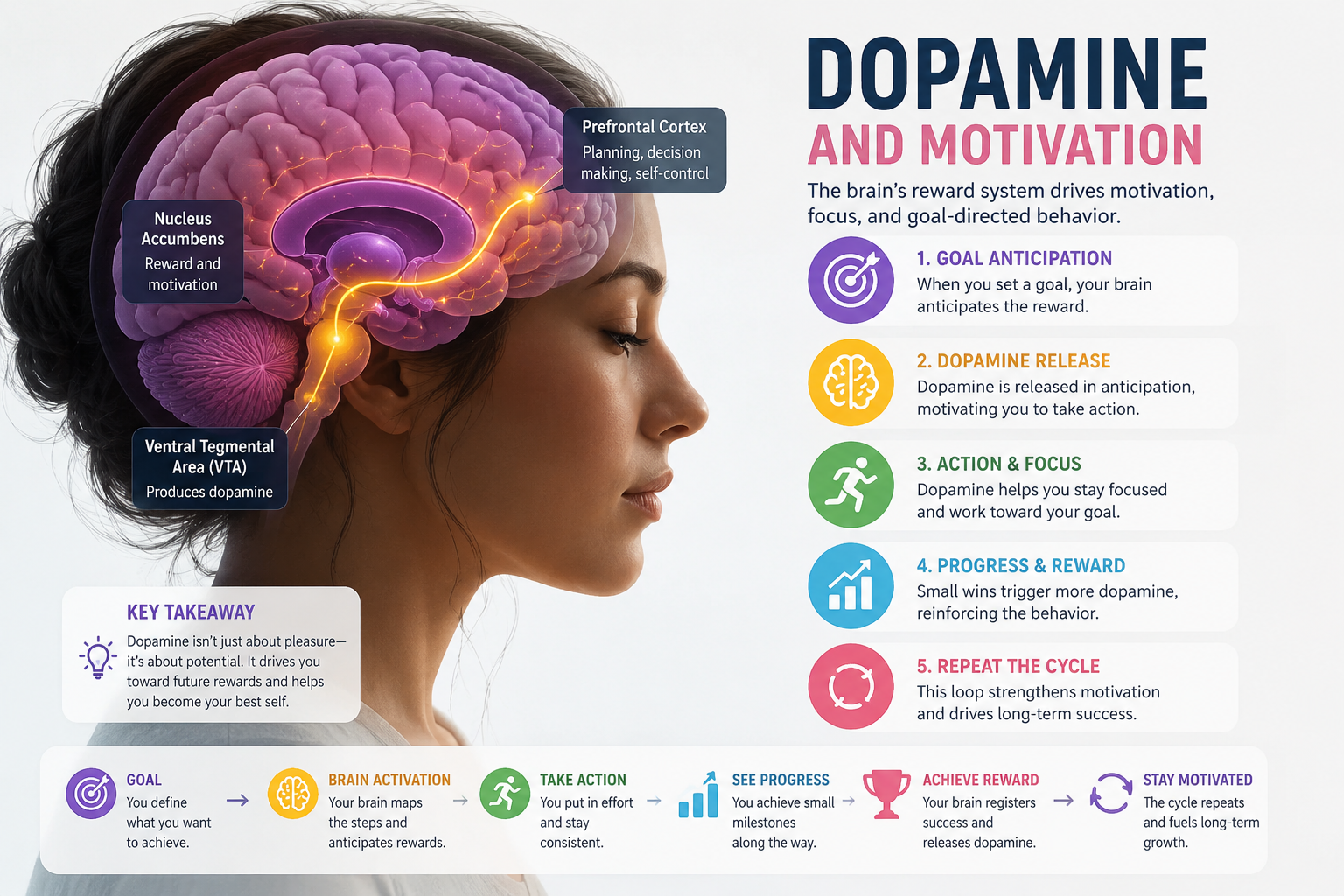
When we set a meaningful goal:
- The prefrontal cortex takes responsibility for planning and decision-making.
- The dopaminergic system provides the energy and focus needed to move forward.
- Each small step of progress triggers a minor dopamine release, reinforcing the behavior.
This scientific cycle is precisely what makes “small goals” and “incremental wins” so effective in practice.
Growth Mindset: A Scientific Foundation for Success
Carol Dweck, a psychologist at Stanford University, introduced the concept of the Growth Mindset through decades of research. Individuals who believe their abilities can be developed through effort and learning respond to failure very differently. They view setbacks not as evidence of inadequacy, but as an integral part of the learning process.
Real-world observations provide further support for this perspective. Many high-achieving entrepreneurs, athletes, and innovators have experienced repeated setbacks before reaching significant success. What distinguishes them is not the absence of failure, but their interpretation of it. Rather than viewing setbacks as evidence of limited ability, they treat them as opportunities for learning, adaptation, and improvement.
In contrast, a Fixed Mindset — the belief that abilities are innate and static — leaves individuals vulnerable to challenges and more likely to give up when things get difficult.
Related Article: How Mindset Affects Success
Importantly, changing your mindset is a real neurological process. Brain imaging studies have shown that with practice and repetition, the cognitive patterns associated with a growth mindset can be genuinely reinforced.
For readers interested in exploring the concept further, Carol Dweck’s TED Talk provides an accessible introduction to the science of growth mindset and its impact on motivation, learning, and long-term success.
Psychological Barriers to Success
1. Procrastination
Researchers now understand procrastination not as a time management problem, but as an emotion regulation response. The individual delays action to avoid anxiety, discomfort, or the fear of failure. The evidence-based solution: lower the activation threshold by breaking tasks into very small, manageable steps.
2. Fear of Failure
Fear of failure is often rooted in the brain’s threat system — the amygdala. Mindfulness-based techniques and cognitive restructuring have been shown to effectively regulate this response over time.
3. Maladaptive Perfectionism
Perfectionism becomes harmful when it shifts from a drive for improvement to a mechanism for avoiding evaluation altogether — causing paralysis rather than progress.
Related Article: 10 Shocking Mind Issues That Cause Failure
Evidence-Based Strategies to Strengthen Motivation
1. SMART Goals with Meaning: Goals that are Specific, Measurable, Achievable, Relevant, and Time-bound are more effective. But beyond structure, meaning matters most — a goal must align with personal values to sustain long-term motivation.
2. Systems Over Willpower: James Clear, in Atomic Habits, argues that environment and behavioral systems are more powerful than sheer willpower. Designing an environment that makes desired behaviors easier is a well-validated, science-backed approach.
3. Self-Compassion: Kristin Neff’s research has shown that self-compassion — not self-criticism — is positively correlated with higher motivation, greater resilience, and better performance.
4. Tracking Progress: Documenting progress, even at a small scale, keeps the dopaminergic system engaged and continuously fuels motivation.
For example, an individual working toward a long-term goal may monitor daily behaviors such as study time, exercise sessions, or completed tasks. Even modest signs of progress can generate a sense of achievement, reinforcing productive behaviors and supporting sustained motivation over time.
Conclusion
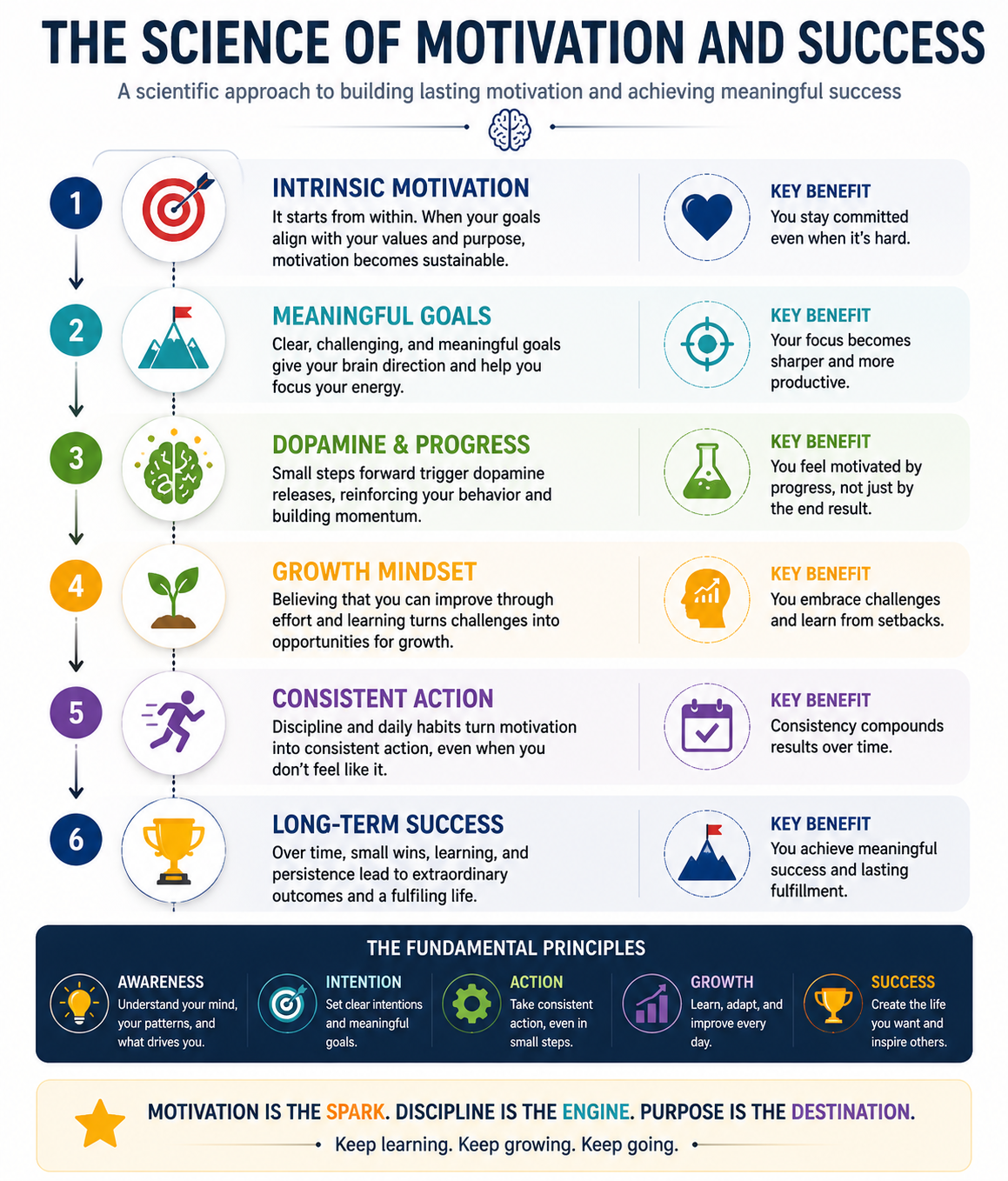
Success is neither the product of exceptional talent nor the result of luck. It is a studyable, learnable, and repeatable process rooted in specific psychological and neurological structures. By understanding these structures and applying evidence-based strategies, anyone can navigate the path to lasting success with greater clarity and intention.
Motivation alone does not guarantee success. However, it provides the psychological fuel that sustains effort, persistence, and learning over time. Long-term success is rarely the result of a single breakthrough; rather, it emerges through consistent action, adaptive thinking, and the ability to remain engaged despite setbacks.
When motivation is supported by effective habits, a growth-oriented mindset, and meaningful goals, individuals are far more likely to achieve sustainable progress in both their personal and professional lives.
At Mindsetopia, we believe that real transformation begins with awareness. Understanding the science behind your own mind is the first — and most important — step. The more we understand the mechanisms that drive our thoughts and actions, the better equipped we become to create meaningful, lasting change.
Frequently Asked Questions (FAQ)
Can motivation be developed, or is it an innate trait?
Research suggests that motivation is not a fixed characteristic. Through goal-setting, habit formation, and supportive environments, individuals can strengthen motivational processes over time.
Is talent more important than motivation?
While talent may provide an initial advantage, evidence consistently shows that persistence, deliberate practice, and sustained motivation are stronger predictors of long-term achievement.
Why do people lose motivation after setting goals?
Goals that are overly ambitious, vague, or disconnected from personal values often fail to sustain motivation. Breaking goals into smaller, meaningful steps can improve engagement and consistency.
What role does dopamine play in success?
Dopamine contributes to anticipation, learning, and goal-directed behavior. It helps maintain focus and reinforces actions associated with progress and achievement.
Can a growth mindset be learned?
Yes. Research indicates that beliefs about ability and intelligence can change over time. Through reflection, feedback, and repeated practice, individuals can develop a stronger growth-oriented mindset.
References
Deci, E. L., & Ryan, R. M. (2000). Self-Determination Theory and the Facilitation of Intrinsic Motivation, Social Development, and Well-Being.
Dweck, C. S. (2006). Mindset: The New Psychology of Success.
Clear, J. (2018). Atomic Habits: An Easy & Proven Way to Build Good Habits and Break Bad Ones.
Neff, K. D. (2011). Self-Compassion: The Proven Power of Being Kind to Yourself.
Table of Contents